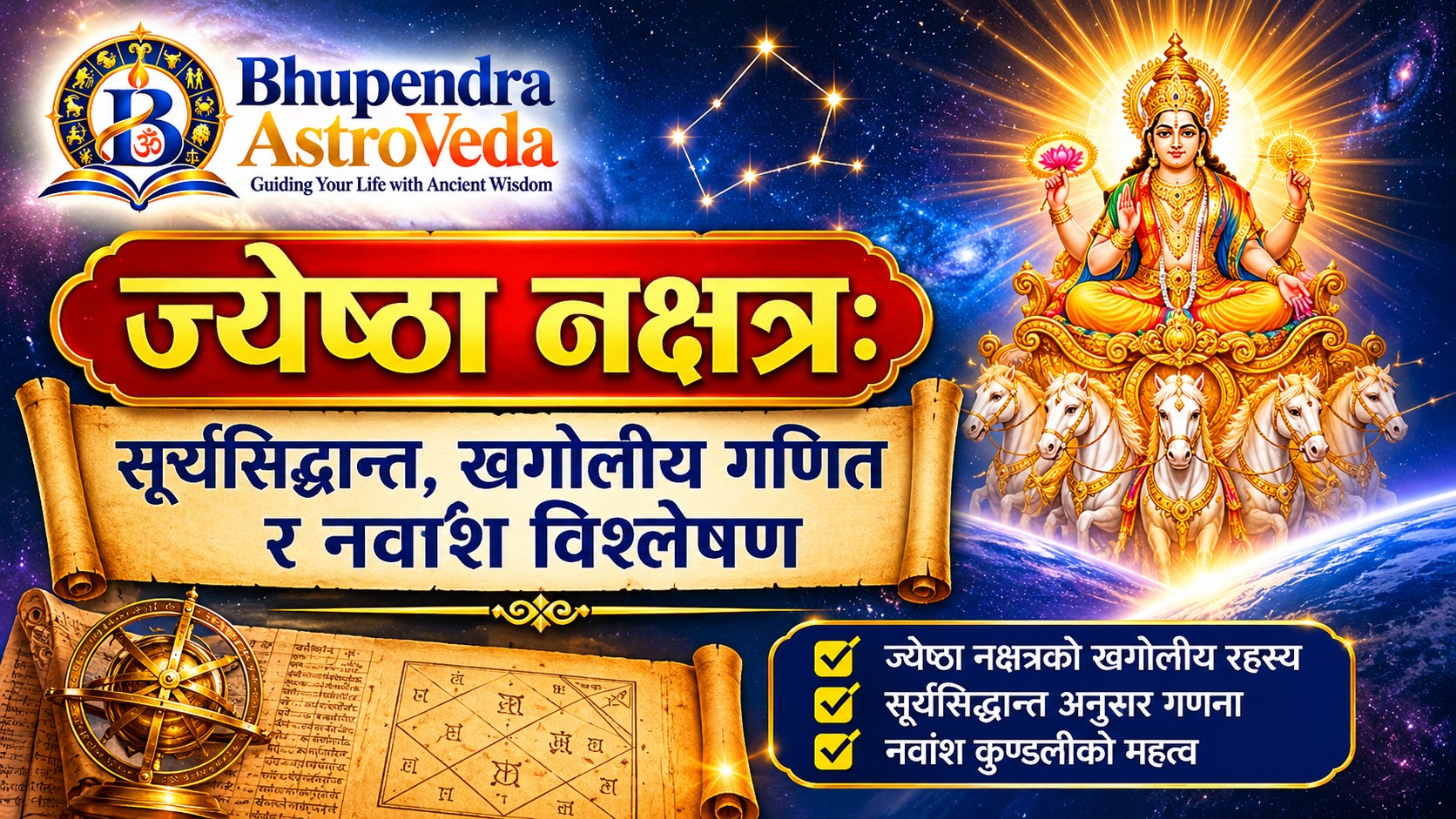
Jyeshtha Nakshatra: Surya Siddhanta, Astronomical Mathematics, and Navamsha Analysis
Introduction and Vedic Background
In Vedic Astrology, Jyeshtha is the 18th Nakshatra among the 27 lunar mansions. Derived from Sanskrit, the term Jyeshtha signifies the eldest, senior-most, or supreme position. It is completely located within Scorpio, ruled by the planet Mercury, with Lord Indra as its presiding deity. To thoroughly analyze Jyeshtha, one must evaluate its astronomical angular extent according to Surya Siddhanta, its mathematical division into four quarters, and the corresponding Navamsha predictive influences.
Surya Siddhanta and Astronomical Computations
According to the foundational astronomical text Surya Siddhanta, the entire zodiac circle spans 360 degrees. Dividing this circle into 12 equal signs gives each sign an extent of 30 degrees, while dividing it into 27 Nakshatras assigns 13 degrees 20 minutes to each Nakshatra. Jyeshtha spans from 16 degrees 40 minutes to 30 degrees within Scorpio. While Surya Siddhanta provides the exact mathematical framework for planetary positions, mapping its four quarters to Navamsha signs belongs to the predictive framework of Vedic Astrology.
Four-Pada Division of Jyeshtha
The total span of a Nakshatra is 13 degrees 20 minutes, which equals 800 minutes of arc. Dividing this equally by four yields 3 degrees 20 minutes for each quarter. Based on this calculation, all four quarters of Jyeshtha lie within Scorpio, but they map sequentially to Sagittarius, Capricorn, Aquarius, and Pisces in the Navamsha chart.
First Quarter - Sagittarius Navamsha
The first quarter of Jyeshtha ranges from 16 degrees 40 minutes to 20 degrees in Scorpio, with the naming syllable 'No' and placement in Sagittarius Navamsha. It is governed by Mercury as Nakshatra lord, Mars as Sign lord, and Jupiter as Navamsha lord. This combination of intellect, research drive, and philosophical wisdom inclines individuals born under this quarter toward law, philosophy, higher research, and principle-driven thinking.
Second Quarter - Capricorn Navamsha
The second quarter ranges from 20 degrees to 23 degrees 20 minutes in Scorpio, with the naming syllable 'Yaa' and placement in Capricorn Navamsha. It is governed by Mercury as Nakshatra lord, Mars as Sign lord, and Saturn as Navamsha lord. Saturn's disciplined influence grants practical thinking, organizational capacity, strong work ethic, and resilience after overcoming initial obstacles.
Third Quarter - Aquarius Navamsha
The third quarter ranges from 23 degrees 20 minutes to 26 degrees 40 minutes in Scorpio, with the naming syllable 'Yee' and placement in Aquarius Navamsha. It is governed by Mercury as Nakshatra lord, Mars as Sign lord, and Saturn as Navamsha lord. As Aquarius represents systemic thinking and innovation, this quarter fosters a scientific temperament, technological inclination, and original social perspectives.
Fourth Quarter - Pisces Navamsha
The fourth quarter ranges from 26 degrees 40 minutes to 30 degrees in Scorpio, with the naming syllable 'Yuu' and placement in Pisces Navamsha. It is governed by Mercury as Nakshatra lord, Mars as Sign lord, and Jupiter as Navamsha lord. The intersection of Scorpio's depth with Pisces Navamsha bestows spiritual awareness, emotional sensitivity, vivid imagination, and strong intuitive capability.
Gandamoola Classification and Jyeshtha
In classical Samhita literature, Nakshatras situated at the junction points of signs and lunar mansions are classified as Gandamoola Nakshatras. These include Mercury-ruled Ashlesha, Jyeshtha, and Revati, as well as Ketu-ruled Ashwini, Magha, and Moola. Jyeshtha marks the transition from water to fire signs, making its fourth quarter a delicate karmic transition point. Being born in Gandamoola is not inherently unfavorable; it bestows intense intellectual sharpness, which traditional remedial rituals further harmonize for positive life outcomes.
Analytical Conclusion
Jyeshtha Nakshatra represents a profound integration of ancient astronomical mathematics and predictive psychology. Understanding its precise angular span from 16 degrees 40 minutes to 30 degrees alongside its Navamsha alignments provides a complete and authentic perspective for astrological research.